I love to work improvisationally, so I thought this theme would be easy for me.
 |
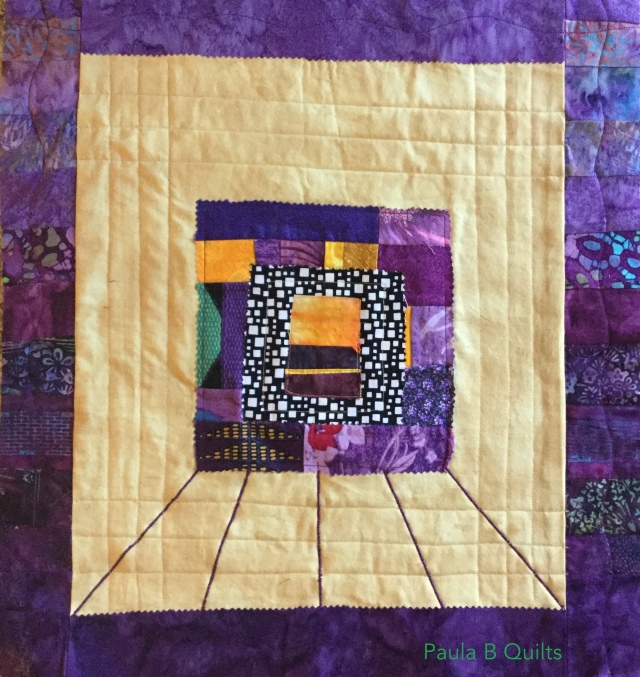
| One of my favorite quilts, from 2011. |
I was determined to do something that would stretch my abilities. And I even had a great idea as soon as the theme was announced! But life intervened and I couldn't get to it. That one is still in my mind to be completed some other time. But to make this deadline, I was going to have to do a smaller project, and I felt like doing something floral.
My initial idea was to have a focal point
of densely stitched flowers in the center, fading out to a suggestion of flowers
and leaves in the middle background, fading out even more to flowers
and leaves stitched white-on-white in the distant background, framed by cutwork spirals. (Wow, words make it sound really complicated.)
An influence for this idea was
Ana Buzzalino's work, especially the pieces where she does one small area in color, and then quilts in white all around it. Another influence was a
quilt I saw in a book somewhere of a tree with huge cutout
areas, and beaded leaves hanging in the negative spaces. (I could not find that image anywhere; if you know the one I am talking about, please let me know!)
And as often happens, once this idea occurred to me, I started seeing versions of it everywhere. I especially liked this one from House Beautiful magazine, showing paper placemats you can doodle on, from
Mulberry Paper and More.
My materials were a vintage linen napkin, wool
batting, a few old satin scraps, and backing.
Starting with a picture of a Dutch still life of
flowers as a reference, I made a quick sketch, planning where I would place emphasis in the composition.
 |
| By Jean-Pierre-Xavier Bidauld (1745−1813) (Web Gallery of Art: Image Info about artwork) [Public domain], via Wikimedia Commons |
 |
| Just the basic lines of the bouquet. |
I copied that sketch with thread onto the quilt sandwich.
I wanted to be sure I liked the cutwork background before I went to the effort of painting and stitching the flowers, so I started with that. I satin
stitched lightly around fabric areas to remove, cut them out, and then satin
stitched again with the wider stitch.
 |
| Some of the cutwork done, after thread sketching. |
On the back of the quilt sandwich, I practiced with Derwent Inktense pencils and Jacquard textile paints. I have used both of those products before, but I wasn't getting the pale pastels I had envisioned. The colors seemed too childish and raw.
Then I
remembered that I had some acrylic inks. T
his article by Judy Coates Perez gave tips about the ink use. I made a little sampler, using dip pens, brushes, and sponges, and then I used it to paint in the flowers on the mini-quilt. Coates Perez says that the ink does not stiffen fabric, and leaves a nice hand, but I found that it was almost as stiff as textile paint. I did dilute it with water as she does, but it still left the fabric stiff enough that I was worried I would break a needle stitching through it.
I painted ink left over in my palette onto more
vintage napkins, and those came in handy later.
At this point I experienced “Halfway Unhappiness,” that stage where it all looks terrible. I was not
getting the faded edges I had hoped for, and I didn’t really like the colors of
the ink. The pink was too salmon-colored and the forest green was too blue. It looked like a coloring book page.
 |
| The "Yuck!" stage. The "How on Earth am I Ever Going to Save This??!!" stage. |
I really enjoyed the time I spent adding hand stitching and beads, but it didn't add the depth and subtlety I was hoping for, and with the ink-coated fabric, it was hard going. If I had months to work on it, maybe I could get the stitching to show up the way I wanted, but the deadline was approaching.
Judging the piece from across the room, the openwork hole on the lower left side really stuck out, too isolated and too round. I thought maybe filling it with some shape would help, That's when I pulled out the extra painted napkins. I found random flower shapes in the paint, like looking at clouds to find pictures, and stitched the flower shapes that I noticed. I cut them out with sharp scissors. The fabric, stiffened from the ink, didn't ravel. I attached the shapes to the quilt with beads and
machine stitching, floating them over the bouquet and the negative spaces.
Finally I went back with extra colored pencil and textile
paint, to bring more unity to the piece.
 |
Dutch Bouquet.
Detail, showing one of the added on pieces. |
 |
| Another detail. |
This piece did not meet my vision for it, and is not one of my favorites, but I do feel that I stretched my skills. I might have been better off to limit my palette and techniques, but that is exactly why I am in in this group -- to try new things and learn what works best for me. This was a great challenge and so much fun to work on!